Cricket Price Boosts & Enhanced Odds: Spotting Genuine Value
 Available in US
Price boosts are the most seductive thing a bookmaker shows you, and I want you to be a little suspicious of them, because seduction is exactly their job. An enhanced price, slashed from its normal level and splashed across the app in bold, is engineered to make you feel you have stumbled on a bargain the bookmaker forgot to hide. Sometimes you have. Far more often, the boost is a carefully calculated piece of marketing that serves the operator’s interests at least as much as yours. After years of taking boosts and declining many more, I can tell you that the skill is not in finding boosts but in telling the genuinely good ones from the theatre, and that is what this piece is about.
I will explain how price boosts actually work, how to distinguish real value from marketing, the stake caps and terms that quietly limit them, and how to use boosts wisely without letting them drive your betting. The honest truth is that a boost is only ever worth taking if the boosted price beats what you can find elsewhere on the same selection, and that comparison, not the size of the boost, is the only thing that matters. Everything else is presentation.
How Price Boosts Work
The mechanic looks generous and often is not, so let me strip away the presentation and show you what is actually happening when a price gets boosted.
A price boost takes a selection and offers it at enhanced odds, a price higher than the operator’s normal market price for that outcome. The site shows you the old price struck through and the new, bigger price beside it, and the visual does the persuading. The boosted selection is usually one the operator has chosen and promoted, often a popular bet, a star player, a heavily backed team, or a multiple combining several fancied outcomes. You are being offered a better-than-normal price, which is real, but on a selection the bookmaker has chosen to put in front of you, which is the part worth pausing on.
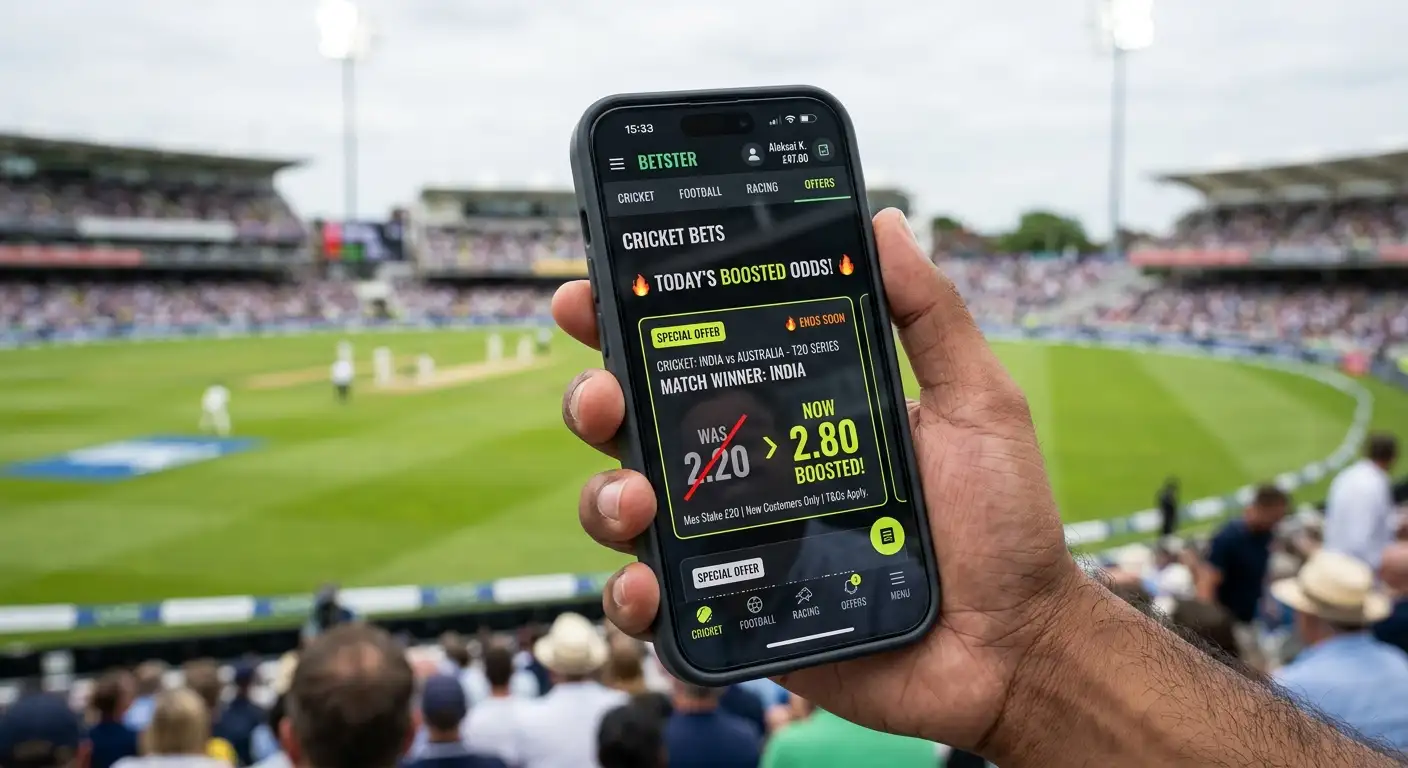
The reason operators offer boosts is straightforward marketing economics. A boost is a customer-acquisition and engagement tool, designed to get you opening the app, betting on something the operator wants to promote, and feeling good about the value you received. Operators have no shortage of selections to choose from when picking what to boost, with the most expansive UK site offering well over 150 markets on a single Test and more than 80 on an IPL or T20 fixture, which gives them a vast menu of popular outcomes to put a boost banner against. The crucial thing to understand is that a boosted price is still set by the bookmaker, and the bookmaker boosts prices it is comfortable laying. A genuinely enhanced price on a selection the operator privately rates as unlikely is no gift at all; it is a fair or even poor price dressed up as a generous one. The struck-through old price is the anchor that makes the new price feel like value, and anchoring is one of the oldest tricks in persuasion. The boost is real; whether it represents value is an entirely separate question.
Telling Genuine Value from Marketing
Here is the single test that cuts through all the presentation, and once you internalise it you will never be fooled by a struck-through price again: compare the boosted price against the best available price for the same selection elsewhere.
A boost is only genuine value if the enhanced price beats what you could get on that exact selection at another licensed operator. The struck-through old price is irrelevant; it is the operator’s own previous price, chosen specifically to make the boost look good, and comparing the boost only against that internal anchor tells you nothing. What tells you everything is the wider market. If the boosted price is longer than the best price available across the market, you have found genuine value. If the market elsewhere already offers a price as good or better without any fanfare, the boost is marketing, however dramatic the struck-through figure looks.

This is why understanding the bookmaker’s margin underpins everything. Every price carries a built-in overround, the margin the bookmaker bakes into its odds, and a boost essentially reduces that margin on a single chosen selection. A boost that genuinely cuts the margin below the market is value; a boost that merely makes a high-margin price look generous is not. The discipline is to treat every boost as a claim to be tested rather than a gift to be accepted, doing the quick comparison against the wider market before you tap. The boosts that survive that test are worth taking. The ones that do not are simply the bookmaker getting you to bet what it wanted you to bet, at a price it was always happy to offer.
Stake Caps and the Terms
The detail that quietly limits the value of most boosts is buried in the terms, and ignoring it is how people overestimate what a boost is actually worth to them.
Almost every price boost comes with a stake cap, a maximum amount you can bet at the enhanced price. The cap is often modest, deliberately so, because it limits the operator’s exposure on the boosted selection. A boost might offer a genuinely excellent enhanced price, but if the maximum stake is small, the actual cash value of the enhancement is limited regardless of how good the price looks. A tempting boost capped at a low stake is a small amount of genuine value, not a large one, and the headline price can make it feel more significant than it is. Always check the cap before you let a boost excite you, because the cap, not the price, determines how much the boost is really worth.

Other terms matter too. Some boosts apply only to specific selections or combinations, some exclude certain markets, and some are tied to particular conditions of settlement. The boosts attached to multiples, several selections combined at an enhanced overall price, deserve particular scepticism, because a boost on a multiple can obscure the fact that the underlying selections still carry the compounded margin and reduced probability of any accumulator. A boosted multiple is still a multiple, with all the long odds against it that implies. Read the terms, find the cap, and understand exactly what is being enhanced and what is not, because the fine print is where the marketing meets the reality, and the reality is usually more modest than the banner suggests.

Using Boosts Wisely
None of this means boosts are worthless, and I do take them, just on my own terms rather than the bookmaker’s, and the distinction is everything.
My approach is to let boosts enhance bets I would have made anyway, never to let them create bets I would not. This is the crucial discipline. If I have already decided to back a selection and a boost offers a better price on it than I can find elsewhere, I take the boost gladly, because it improves a bet I was going to place. What I never do is let a boost tempt me into a selection I had no interest in, simply because the enhanced price looks attractive, because that is precisely the behaviour the boost is engineered to produce, and it means the bookmaker is choosing my bets for me.

So I treat boosts as a final check at the point of betting rather than a source of betting ideas. I form my view, decide my selection, and then look to see whether a boost happens to offer the best price on it, comparing against the wider market and noting the stake cap. A boost that passes those tests is free value on a bet I wanted; a boost that fails them is marketing I decline. The closely related question of Best Odds Guaranteed, which is the cleaner, catch-free cousin of the price boost, is something I cover in my piece on Best Odds Guaranteed in cricket. The overarching principle is the same for both: value is defined by the market, not by the bookmaker’s presentation, and the punter who keeps that straight will take the genuine boosts and leave the theatre alone. Let the bookmaker enhance your bets; never let it choose them.
Are cricket price boosts ever genuinely good value?
Yes, but only when the boosted price beats the best available price for the same selection elsewhere across the market. The struck-through old price the operator shows is its own anchor and tells you nothing. Compare the boost against the wider market, and if it offers a longer price than you can find without fanfare, it is genuine value worth taking.
Why do boosts have stake caps?
The cap limits the operator’s exposure on the enhanced selection, which is why boosts are often capped at modest stakes. The cap, not the headline price, determines how much a boost is really worth to you, so a tempting price capped at a low stake represents only a small amount of genuine value. Always check the cap before letting a boost excite you.
Created by the ”Best Cricket Betting Sites” editorial team.