Cricket Free Bets & Welcome Offers: A UK Punter’s Value Guide
 Available in US
I once spent an afternoon working out the real value of a “£30 in free bets” offer that had been flashing at me from every cricket site for a week. By the time I’d accounted for the qualifying stake, the minimum odds, and the fact that a free bet doesn’t return your stake, the headline £30 was worth closer to £18 in actual expected value — and that was before I’d factored in whether I even wanted to place the bet the offer required. That afternoon changed how I read every promotion since. The number on the banner is marketing. The number that matters is the one you have to calculate yourself.
This guide is about doing that calculation. Cricket free bets and welcome offers are a real part of the value landscape — sports betting is the largest segment of UK online gambling, accounting for 56.64% of online revenue as of 2024, and operators compete hard for your sign-up because that segment is so lucrative to them. The flip side is that every offer is engineered to look more generous than it is. My job here is to hand you the tools to see through the engineering, so the offers you claim are the ones that genuinely add value and the ones you skip are the ones designed to cost you. None of this requires a maths degree — it requires the willingness to spend two minutes with the terms before you spend an afternoon chasing a rollover.
Table of Contents
How Cricket Offers Actually Work
Strip away the branding and almost every cricket welcome offer is one of a small handful of structures wearing different clothes. Learn the structures and you stop being dazzled by the wrapping.
The most common is the matched free bet: you place a qualifying bet of a set amount, and the site credits you a free bet in return, often matching your stake up to a cap. The second is the deposit match, where the operator adds a percentage of your first deposit as bonus funds. There are variants — bet-and-get offers, risk-free first bets, enhanced odds on a sign-up selection — but they all share a common DNA. Each one requires you to put your own money in play first, each one attaches conditions to the bonus that follows, and each one is priced by the operator to deliver a positive return to them across the thousands of punters who claim it. The UK market is enormous — the country generated around £6.9 billion in online gambling gross gaming yield across a recent twelve-month period — and that scale is built on offers that look like gifts and behave like investments for the house.

The single most important thing to understand is the difference between bonus funds and real money. When you win a normal bet, your stake comes back with your winnings. A free bet almost never returns the stake — you keep the profit, not the notional amount staked. That one detail quietly lops a chunk off the headline value of every free bet offer, and it’s the first thing I check before I get anywhere near the terms.
It’s worth dwelling on why operators structure things this way, because once you see the logic you’ll never read an offer the same again. A welcome bonus is a customer-acquisition cost to the bookmaker — it’s the price it pays to get you through the door and, more importantly, to get you betting habitually. The whole structure is calibrated so that the average claimant generates more lifetime margin than the bonus costs to award. That isn’t a scandal; it’s simply how the economics work, and it’s why no offer is ever as generous as it looks. The operator has run the numbers across millions of sign-ups, and the house edge is built into the offer just as surely as it’s built into the prices. Your task isn’t to find the offer with no catch — there isn’t one — but to find the offers where the catch is small enough that the value still tips in your favour.
Matched Free Bet versus Deposit Match: Reading the Difference
Early in my betting life I treated a “£50 deposit match” and a “£50 in free bets” as roughly the same deal. They are not, and conflating them is how you end up disappointed. The two structures release value in completely different ways and suit completely different punters.
A matched free bet is tied to action. You bet your own money, you get a free bet, and crucially you don’t usually have to wager the free bet’s winnings many times over before withdrawing — the conditions tend to sit on the qualifying bet and the free bet itself rather than on an endless rollover. A deposit match is the trickier beast. The bonus funds it hands you are almost always locked behind wagering requirements: you must stake the bonus, sometimes the bonus and the deposit, a set number of times before any of it converts to withdrawable cash. A “100% up to £50” deposit match with a high rollover can require you to stake hundreds of pounds before you see a penny of the bonus as real money.

My rule of thumb is that matched free bets are usually the cleaner value for a casual cricket punter, because the path from offer to usable funds is shorter and the conditions are easier to satisfy honestly. Deposit matches can be worth more in absolute terms, but only if you were going to bet through the rollover anyway — and most people overestimate how much they’ll actually wager. The structure that suits you depends entirely on how you bet, which is why the same offer is a good deal for one punter and a trap for another.
There’s a behavioural trap baked into the deposit match that I’ve fallen into myself and watched plenty of others fall into too. Once you’ve deposited to claim a bonus and started working through a rollover, the sunk cost of the turnover already placed makes it psychologically harder to stop, even when stopping is the rational move. You keep betting to “free” the bonus, and the betting itself is where the operator makes its money. The matched free bet doesn’t carry that gravitational pull in the same way, which is another reason I steer casual punters toward it. The cleanest offer is the one that doesn’t quietly change how much you bet.
Wagering Requirements and Minimum Odds: Where the Value Leaks Out
If there’s one section of this guide to read twice, it’s this one, because wagering requirements and minimum odds are where the headline number quietly bleeds away. They’re also the conditions operators bury deepest in the terms, which should tell you how much they matter.
A minimum-odds requirement dictates that your qualifying bet, or the free bet itself, must be placed at or above a certain price — commonly something like evens or 1.50 in decimal terms. This sounds trivial until you realise it forces you onto riskier selections than you might choose freely, which raises the chance of the qualifying bet losing and shifts the expected value back toward the operator. Wagering requirements go further: they specify how many times bonus funds must be staked before withdrawal. A “20x wagering” condition on a £25 bonus means £500 must pass through your account before the bonus is yours, and every pound of that turnover is exposed to the bookmaker’s margin.

This is where understanding the overround pays off directly. On the sharpest international markets the margin sits around 4 to 5%, against an industry norm of 5 to 8% — and every rotation of a wagering requirement takes another bite at that margin. Run £500 of turnover through a 6% book to clear a bonus and you’ve handed back, on average, around £30 in margin in the process of trying to free a £25 bonus. Suddenly the gift costs more to unwrap than it contains. I always do this rough sum before chasing a deposit match: turnover required, multiplied by the typical margin, against the bonus on offer. If the margin cost approaches the bonus, the offer isn’t value, it’s a marketing exercise with my money. Treating your bankroll with the same discipline you’d apply to any other spending is the habit that keeps these calculations honest.
ACCA Insurance, Best Odds Guaranteed and the Ongoing Offers
Welcome offers grab the headlines, but the promotions that actually matter over a cricket season are the recurring ones — and these are far easier to evaluate because they don’t usually come wrapped in wagering requirements. The trade-off is that they apply to specific bet types, so their value depends on whether you bet that way anyway.
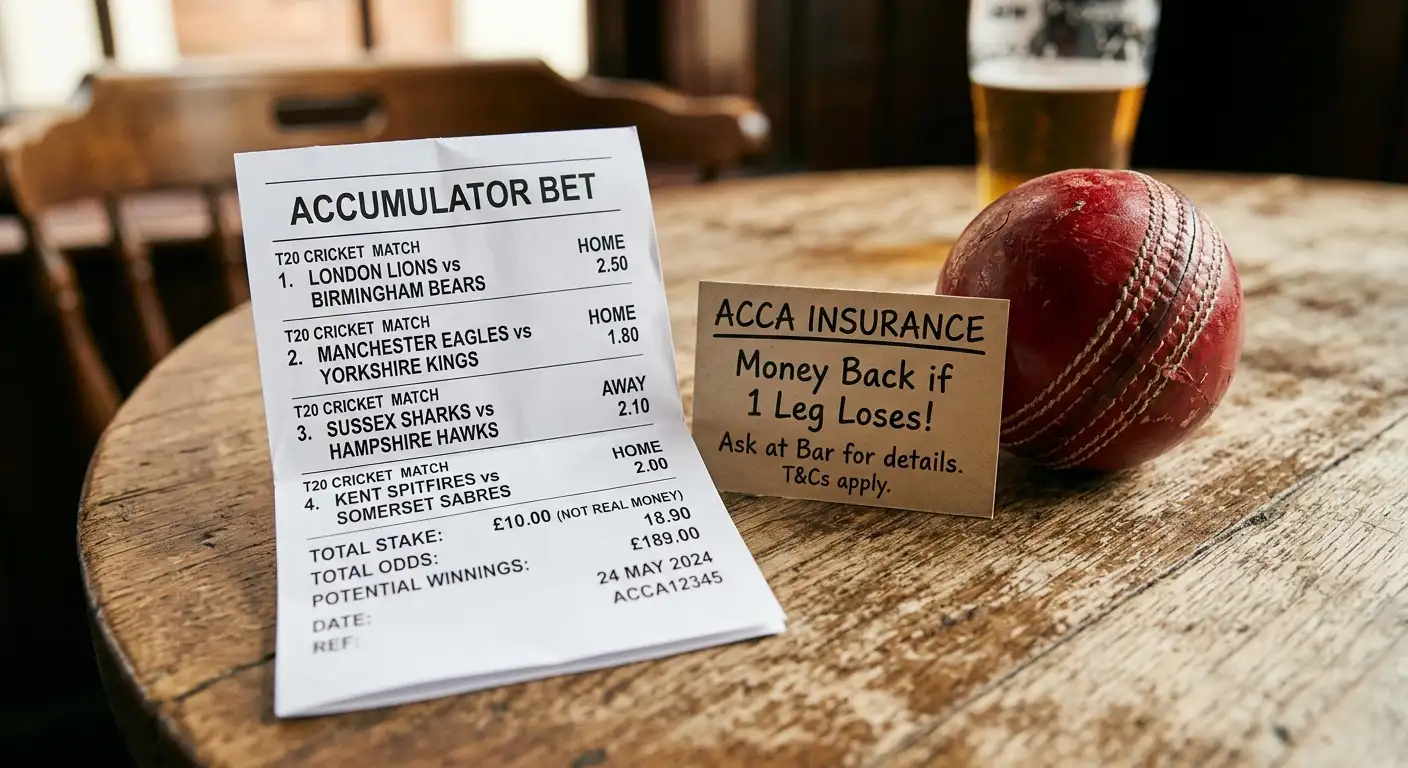
Acca insurance refunds your stake, usually as a free bet up to a cap, if a single leg of a qualifying accumulator lets you down. For a punter who bets multiples regularly it’s genuinely useful, because it softens the worst feature of the accumulator — the one near-miss that costs you the lot. Best odds guaranteed is the other recurring offer worth knowing: if you back a horse or, increasingly, a cricket selection at one price and the starting price drifts longer, the operator pays you at the bigger price. The catch with all of these is breadth of markets. An offer is only valuable if the site carries the markets you want to bet — and the operators with the widest cricket books, running well over a hundred markets on a single high-profile fixture, give a promotion far more surface area to be useful than a site with a thin board ever could.
My approach to ongoing offers is the opposite of my approach to welcome offers. With a sign-up bonus I’m sceptical by default and calculate before claiming. With recurring promotions I lean in, because the value is cleaner and they reward the way I already bet rather than forcing me into bets I wouldn’t otherwise place. The key is to let the offers fit your betting, never the other way round.
The breadth point deserves a moment more, because it’s the one most punters miss when they sign up chasing a welcome bonus. A site might offer the most attractive headline promotion in the market, but if its cricket board is thin — a handful of markets on the marquee games and nothing on the domestic stuff — then every recurring offer it runs has almost nothing to attach to. By contrast, an operator carrying well over a hundred markets on a big fixture and eighty-plus on IPL and T20 games gives best odds guaranteed and acca insurance a vast surface to be useful across. I’d rather have a slightly meaner welcome bonus at a site with a deep board than a fat sign-up offer at one whose markets dry up the moment the headline fixture ends. The board outlasts the bonus.
Calculating the Real Value of an Offer
Here’s the arithmetic I promised you, the same sum I ran on that £30 offer years ago. It’s not complicated, and once you’ve done it a few times you’ll do it in your head before the banner has finished animating.
Start with the headline bonus. Subtract the value lost because a free bet doesn’t return its stake — as a working figure, a free bet is worth roughly 70 to 80% of its face value, because you keep the winnings but not the notional stake. Then account for the qualifying bet: if you must risk £10 to unlock the bonus, that £10 is genuinely at risk, and at typical minimum odds it has a real chance of losing. Finally, for any bonus carrying a wagering requirement, multiply the required turnover by the typical margin and treat that as a cost. What’s left after all three deductions is the offer’s true expected value — and it’s almost always a fraction of the number on the banner.
Let me run a clean, brand-free example. Suppose an offer gives you a £20 free bet for a £10 qualifying stake at minimum odds of evens, with no wagering on the free bet. The £20 free bet is worth around £15 in real terms once you account for the unreturned stake. Your £10 qualifier is genuinely at risk, so its expected cost is a few pounds depending on the odds. Net it out and the offer’s real value is perhaps £11 or £12, not £20 — still positive, still worth claiming, but worth a little over half what the headline implied. Now run the same sum on a deposit match with a 20x wagering requirement and the answer often flips negative. The arithmetic is the only thing that tells you which is which, and the operators are betting heavily that you won’t do it.
One refinement makes the sum sharper still. The expected cost of your qualifying bet depends on the price you’re forced to take. At minimum odds of evens, a £10 qualifier loses roughly half the time, so its average cost across many claims is meaningfully more than at lower minimum odds — except lower minimum odds aren’t usually on offer, precisely because the operator wants the qualifier to carry real risk. This is why two offers with identical headline bonuses can have very different true values: the one with the higher minimum-odds requirement quietly costs you more on the qualifying leg. When I compare offers, I line them up not by headline number but by net expected value after the qualifier and any rollover, and the ranking that produces almost never matches the order the marketing puts them in.

The Red Flags That Tell You to Walk Away
After enough years you develop a nose for the offers built to look generous and behave otherwise, and a few specific terms set off the alarm every time. Learn these and you’ll screen out the worst offers in seconds.
The first red flag is a high wagering requirement attached to a deposit match — anything in the 30x-and-up range is usually engineered so that the average claimant never sees the bonus as cash. The second is a short expiry window: bonuses that must be used within a few days push you into rushed, poorly considered bets, which is exactly the behaviour the operator wants. The third is a restrictive market list, where the free bet can only be used on selections at long odds or specific exotic markets carrying fat margins. The fourth is a maximum-winnings cap on bonus funds, which quietly limits your upside while the downside stays uncapped.
There’s a fifth that’s subtler and that I missed for years: the game-weighting clause. Some terms count cricket bets at only a fraction of their stake toward the wagering requirement, so a £10 cricket bet might contribute just a few pounds of the turnover you need. Read in isolation the rollover looks achievable; read with the weighting clause, it balloons. I now scan specifically for how cricket is weighted in any deposit match, because an offer that weights the sport you actually want to bet at a low percentage is telling you, in the small print, that it isn’t really for cricket punters at all.
None of this is hidden law-breaking — these are perfectly legal terms at UKGC-licensed sites, which is rather the point. The protection isn’t that the offers are policed into fairness; it’s that the regulator forces the terms to be disclosed, and the responsibility to read them is yours. The wider industry has come under real pressure to behave more responsibly, and as Claire Murdoch, NHS England’s national mental health director, has put it, it is only right that this billion-pound industry steps up to support people suffering from gambling addiction. Offers are the sharp end of that industry’s marketing, and the single best habit you can build is to treat every promotion as something to evaluate coldly rather than a gift to grab. The banner is designed to bypass your judgement. Doing the sum is how you switch your judgement back on.
Wagering requirements specify how many times you must stake bonus funds before any of it can be withdrawn as real money. A 20x requirement on a £25 bonus means £500 must pass through your account first, and every pound of that turnover is exposed to the bookmaker’s margin. Matched free bets usually carry lighter conditions than deposit-match bonuses, so always read the rollover figure before claiming, because a high requirement can cost you more in margin than the bonus is worth. Almost never. With a free bet you keep the winnings but not the notional stake, which is the opposite of a normal bet where your stake comes back with your profit. That single detail means a free bet is worth roughly 70 to 80% of its face value in real terms, so a ‘£20 free bet’ is closer to £15 of genuine value before any other conditions are applied. It is the first thing to account for when judging any offer. Minimum odds on a qualifying bet commonly sit around evens or 1.50 in decimal terms, meaning your bet must be placed at or above that price to count toward the offer. The effect is to push you onto riskier selections than you might choose freely, which raises the chance the qualifying bet loses and shifts the expected value back toward the operator. Always check the minimum-odds rule before placing the qualifier, because it materially affects whether the offer is worth claiming.What are wagering requirements on a cricket free bet?
Do free bet returns include the stake?
What minimum odds usually apply to qualifying cricket bets?
Published by the Best Cricket Betting Sites team.