Decimal vs Fractional Cricket Odds: Reading the Price Correctly
 Available in US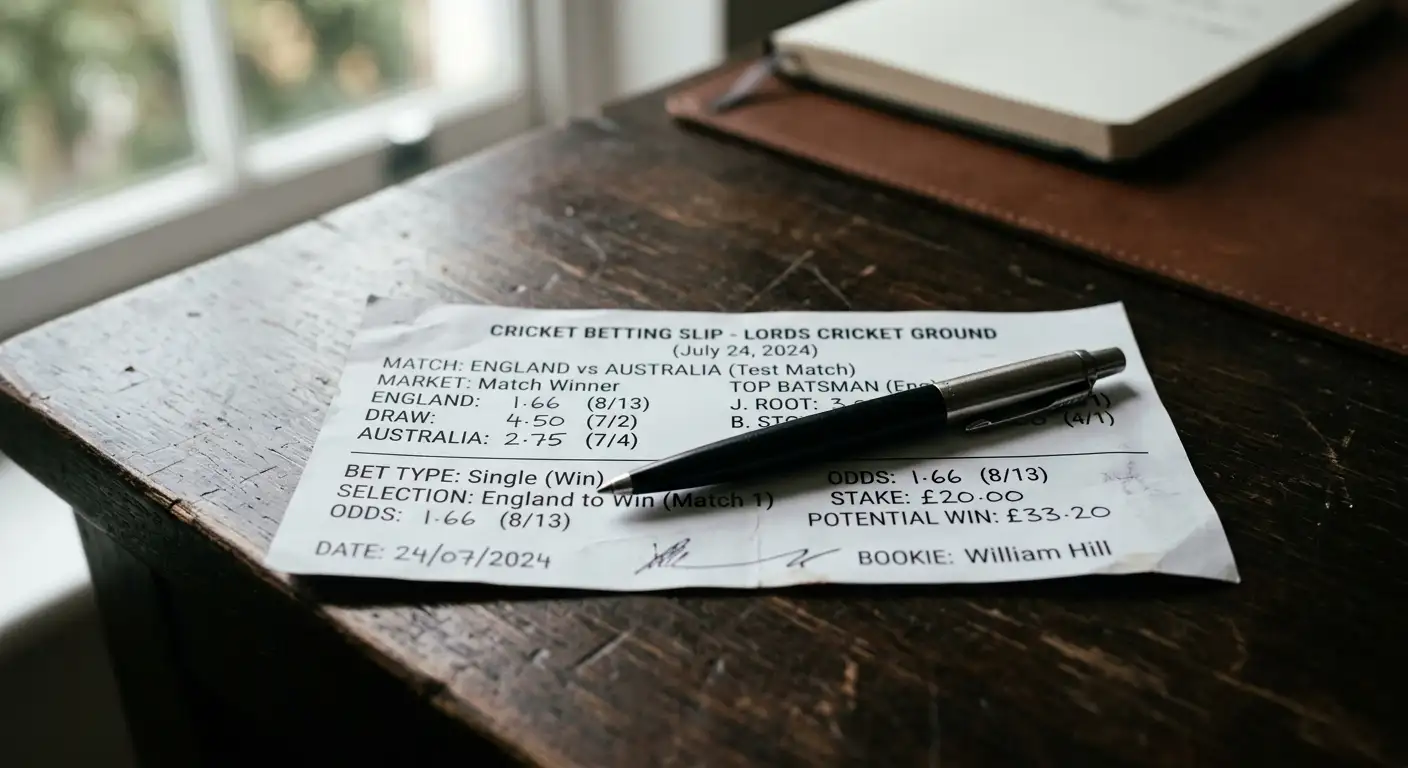
I once spent a genuinely embarrassing amount of time, early in my career, mentally converting every fractional price into decimal before I could decide whether it was any good. Friends would ask me for a quick read on a market and I would go quiet, doing arithmetic in my head like a flustered cashier. The truth I eventually accepted is that there is nothing clever about preferring one odds format over the other. They describe exactly the same thing. The only thing that matters is that you can read whichever one is in front of you instantly, because hesitation costs you in fast markets and the player-specific and live markets that now make up over a third of all cricket betting move quickly.
British betting grew up on fractions. Walk into any high-street shop and you will see prices like 7/2 chalked up, because that is the language the trade was built in. Online, though, decimal odds have quietly taken over, and most cricket sites let you switch between the two with a single setting. So this is not a debate about which is better. It is a short, practical lesson in reading both so you never freeze on a price again.
What the Two Formats Actually Mean
Picture two people describing the same journey, one giving you the total distance and the other giving you only how much further you have to go. That is the entire difference between decimal and fractional odds, and once you see it that way the confusion evaporates.
Decimal odds tell you the total you get back for every one pound staked, including your stake. A price of 3.00 means a winning one-pound bet returns three pounds: your pound plus two pounds of profit. To find your total returns you simply multiply your stake by the decimal number. That is it. There is no second step, which is precisely why traders and exchanges adopted decimals and why I now think in them by default.

Fractional odds tell you only the profit, expressed as a ratio of profit to stake. A price of 2/1, said as two to one, means you win two pounds of profit for every one pound staked, and you also get your stake back on top. So 2/1 in fractional is the same proposition as 3.00 in decimal. The fraction hides your returned stake, which is the bit that trips beginners up. Whenever you see a fraction, remember the stake comes back as well unless the bet loses.
Some fractions look intimidating only because the numbers are awkward. A price of 11/8 means eleven pounds of profit for every eight staked. It is not a different kind of bet, just a less tidy ratio. Evens, written as 1/1 or shown as 2.00 in decimal, is the dividing line: above it you are backing an outsider that pays more than your stake in profit, below it you are backing a favourite that pays less.
Converting Between Them Without a Calculator
The conversion that unlocked everything for me is almost insultingly simple, and I wish someone had told me it on day one instead of letting me grind through long division for a fortnight.

To turn a fraction into a decimal, divide the first number by the second and add one. Take 7/2: seven divided by two is 3.5, add one and you get 4.50 in decimal. The plus one is your returned stake making its appearance, since decimals include it and fractions do not. Try 5/4: five divided by four is 1.25, add one, and you have 2.25. Once that single rule lives in your head, every fraction on a UK cricket site becomes a decimal in about a second.
Going the other way is just as quick. To turn a decimal into a fraction, subtract one and express what remains as a ratio. A decimal of 4.00 minus one is 3, which is 3/1. A decimal of 1.50 minus one is 0.5, which expressed as a fraction over one is 1/2. The subtraction strips out the stake that the fraction never wanted to mention in the first place.
The reason this matters for cricket specifically is that you will frequently compare prices across formats and markets in the same session. A site might show outright tournament odds in fractions and live in-running prices in decimals, and you cannot judge value if you are stuck translating. Speed of reading is not a party trick. It is the foundation of spotting whether a price is generous, and the margin baked into that price, the overround, is something I unpack fully in my piece on cricket overround and bookmaker margin.
Calculating Your Returns Correctly
Let me run a clean example with safe, made-up numbers, because this is where format confusion turns into real money lost.
Say you back a team at 3.50 in decimal and stake ten pounds. Total returns are stake times odds: ten times 3.50 is 35 pounds. Of that, ten pounds is your own stake coming back and 25 pounds is profit. Now take the same bet quoted as a fraction, which would be 5/2. Profit is stake times the fraction: ten times five divided by two is 25 pounds profit, plus your ten-pound stake back, for the same 35 pounds total. Identical bet, identical outcome, two ways of writing it.

The single most common error I see is people reading a fraction as if it were a decimal. Someone sees 5/2 and assumes a ten-pound bet returns fifty pounds, because they have mushed the numbers together. It does not. That confusion almost always works against you, inflating what you think you are winning and leading you to stake more than you should. Pick one format, set your site to display it, and stick with it until reading the other is effortless.

Here is a subtle point that separates casual punters from sharper ones. The overround, the bookmaker’s built-in margin, lives inside these prices regardless of format, and at the top end of the market for international Test and one-day cricket it tends to sit around four to five percent against an industry norm closer to five to eight percent. You will never spot the difference between a fair price and a stingy one if you are still wrestling with conversions. Reading odds fluently is the prerequisite for everything else, including judging value.
Which Format UK Sites Use and How to Switch
Every UK-licensed site I have used lets you choose your odds format, usually buried in account settings or sitting as a small toggle near the bet slip. There is no wrong choice, only the choice you can read fastest.

My honest recommendation, after years of doing this professionally, is to learn decimals as your working format. They make calculating returns a single multiplication, they compare cleanly across markets, and they are the language of the betting exchanges where the sharpest money sits. Keep fractions in your back pocket for reading the high street and for the parts of the sport that still default to them, but do your real thinking in decimal.
Whichever you pick, the discipline is the same: read the price, calculate the returns before you stake, and never confirm a bet whose maths you have not done. The format is just the dialect. Fluency in it is what stops you from making the unforced errors that quietly drain a betting bank over a season.
How do I convert fractional odds to decimal?
Divide the first number of the fraction by the second and add one. So 7/2 becomes 3.5 plus one, which is 4.50 in decimal. The added one represents your returned stake, which decimal odds include and fractions leave out.
Do UK cricket sites let me switch odds format?
Yes. Every UK-licensed site I have used offers a setting, usually in account preferences or near the bet slip, to display odds as either decimal or fractional. There is no difference in the actual prices, only in how they are written, so choose whichever you read fastest.
Published by the Best Cricket Betting Sites team.